What Would AI Do? The Mindshift That Separates Users From Innovators (WWAID)
Stop Asking What You Can Do With AI. Start Asking What AI Would Do.

This week at ServiceNow, we hosted an internal AI Innovation event that left me incredibly energized about what’s next.
We kicked off with a powerful keynote from Jeremy Utley, author of Ideaflow and director of executive education at Stanford d.school. He shared how AI can amplify human creativity and unlock new ways of thinking.
We then spotlighted Amit Zavery, our President, CPO, and COO, who’s been leading our journey to becoming truly AI-native!
We also featured insights from Paul Hong, ServiceNow VP of Design and Swati Raju, VP of Engineering.
During a our conversation, Paul asked me:
“Brian, from your perspective, how does adopting an AI-native mindset expand what’s possible — for individuals, teams, or even entire product areas? Can you share an example where integrating AI sparked a new idea, accelerated a project, or revealed a possibility that didn’t exist before?”
Here’s how I’m thinking about it 👇
The mindset shift for me is stepping back and exploring what I didn’t know to know.
An AI-native mindset implies AI isn’t an add-on. It’s the core. If AI weren’t part of the equation, the solution wouldn’t (or couldn’t) exist.
That requires the acceptance of an uncomfortable truth: I am in the way.
In any decision, exploration, consideration, when I might prompt AI to help me, I consciously or subconsciously direct the outcome. And while that might sound like exactly what needs to be done, I’m not inviting or opening the door to new or novel or inventive alternatives.
How I think, my approach, my assumptions and biases are inherently not AI-native.
Therefore, the output on the other side of AI is just a reflection of the thinking and design that went into it.
My approach, my prompt, needs to start from a differently place to channel a different outcome.
To truly embrace an AI-native mindset and to ignite innovative outcomes, I have to stop thinking about, “What would I do?” as I form my prompts and instead ask:
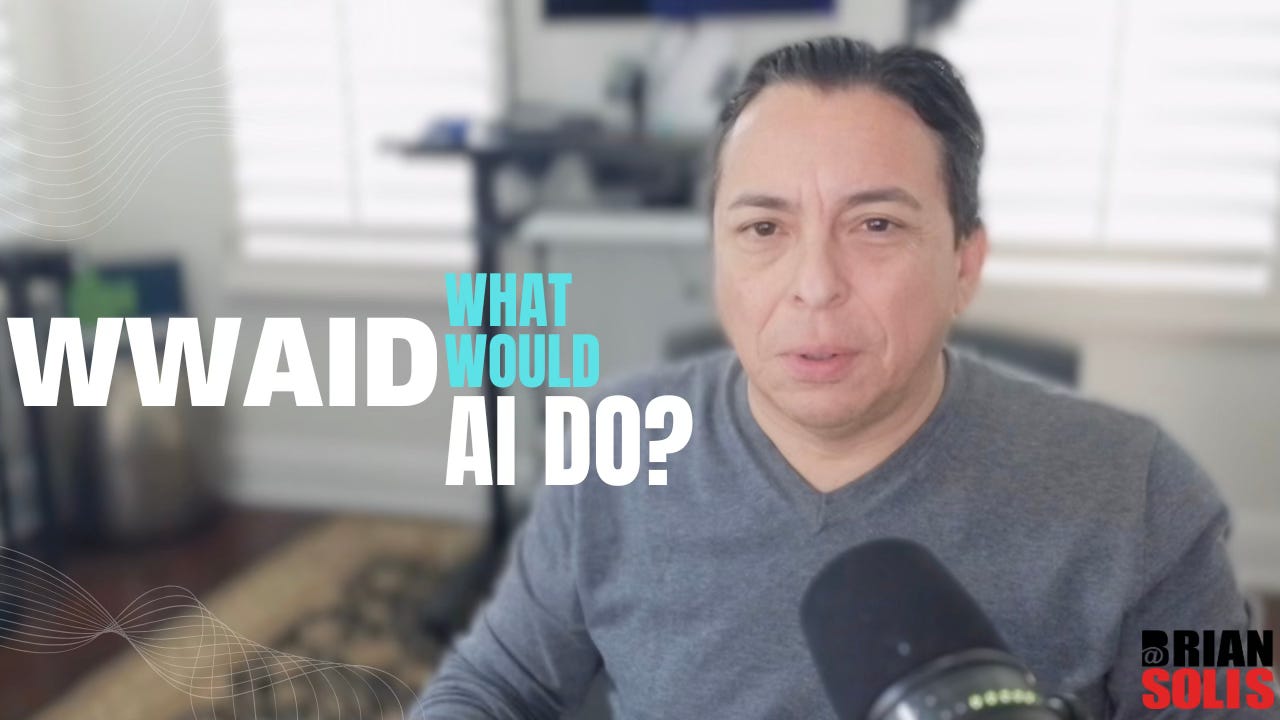
WWAID...“What would AI do?”
When I start there, I’m forced to rethink my prompts, my constraints, and my expectations.
I shift from drawing on “known knowns” to intentionally designing for possibility.
That’s where innovation lives...in the creation of new value.
QuantumBlack, AI by McKinsey research shows that reimagining end-to-end workflows with AI is the #1 driver of EBIT impact. Not bolting-on AI, but rethinking the whole system.
Please watch the video for the rest of the story...
That’s the power of an AI-native mindset: treating AI not as a tool to speed up what we already do, but as a partner to help us discover what we couldn’t see before.
Read Mindshift | Book Brian as a Speaker